What "may contain" means on a food label
"May contain [allergen]" and "produced in a facility that also uses [allergen]" are advisory statements about possible cross-contact. In the US they're not required by law, so their presence or absence doesn't tell you how much risk there is. Decide with your doctor how to treat them, and apply the same rule every time.
What the warning is for
Cross-contact happens when an allergen gets into a food unintentionally, for example from shared equipment, the same production line, or dust in the air. The FDA says advisory statements may be used to address unavoidable cross-contact, but only when the manufacturer has already followed good manufacturing practices, and they can't be used instead of those practices.
The common wordings
- "May contain peanuts"
- "May contain traces of tree nuts"
- "Produced in a facility that also processes milk"
- "Made on shared equipment with wheat"
There's no legal difference in meaning between these phrasings, and none of them is a measurement of how much allergen might be present.
How to decide
How you treat advisory labels depends on how sensitive you are, and that's a conversation for your doctor or allergist. What helps most is having one rule and applying it every time, rather than deciding product by product in the aisle. When in doubt, the FDA recommends contacting the manufacturer named on the label.
"Free from" claims
A "peanut-free" or "free from nuts" claim is different again: the manufacturer is telling you the allergen isn't there. It doesn't trigger an allergen alert in SafeScan, which reads "free from" statements separately from the ingredients.
How SafeScan handles advisory warnings
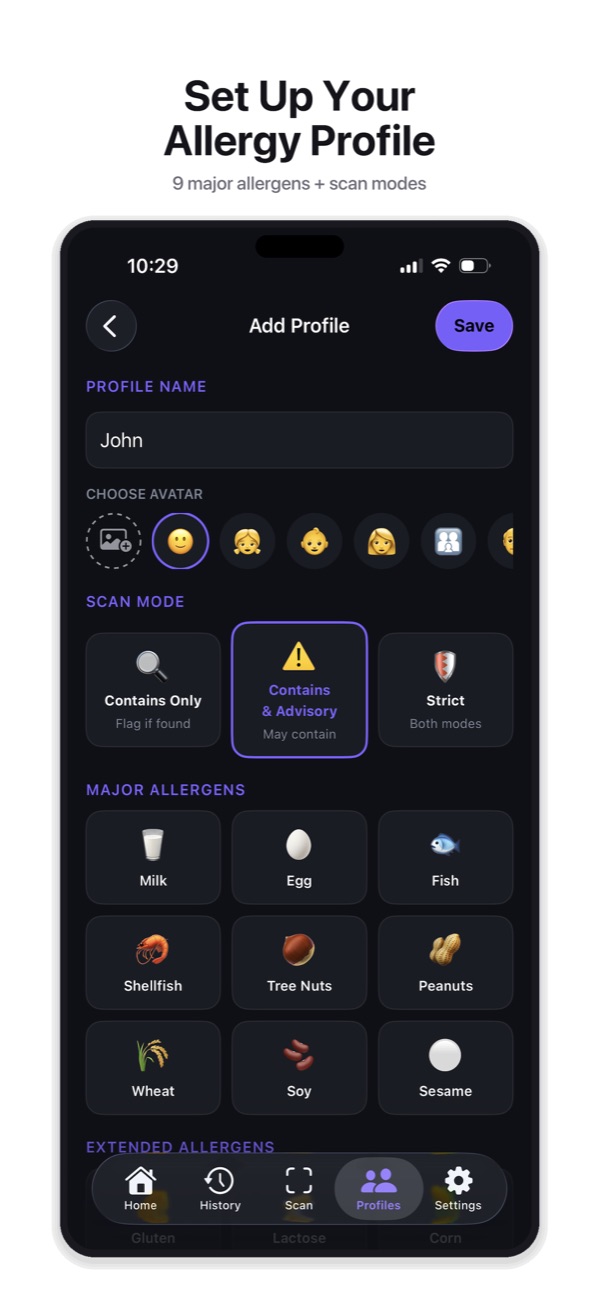
SafeScan reads "may contain" and facility statements separately from the ingredient list. What it does with them depends on the profile's sensitivity mode:
- Contains Only: advisory warnings aren't flagged.
- Contains & Advisory: they're flagged, and the product gets a Review verdict so you can check the label yourself.
- Strict: they're flagged, and unknown or uncertain ingredients are treated as potentially unsafe too.
Each family member can have their own mode. More about sensitivity modes.
This guide is general information based on US labeling rules, not medical advice. Talk to your doctor or allergist about your own allergies, and always read the label on the package in your hand.
Choose how strict SafeScan is
SafeScan's sensitivity modes let each profile decide whether "may contain" warnings count. Contains Only flags direct hits, Contains & Advisory adds advisory warnings, and Strict also flags unknown ingredients.
Download on the App StoreFree to download for iPhone and iPad. No account needed, and your profiles and scan history stay on your device.
Frequently asked questions
Is "may contain" required by law?
No. The FDA says advisory statements such as "may contain" or "produced in a facility that also uses" are not required by law. When used, they must be truthful and not misleading.
Does no warning mean no cross-contact?
No. Because the warnings are voluntary, a product without one may still have been made on shared equipment. Contact the manufacturer if you need to know.
Is "may contain" the same as "Contains"?
No. "Contains" lists allergens that are ingredients in the product. "May contain" describes a possible unintended presence from cross-contact.